
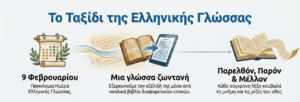
Introduction
The Greek language is a way of thinking, remembering and communicating. It is a language that travels through time, changes form, keeps its core and continues to speak to each generation.
With the series “The Journey of the Greek Language” we begin a journey based on the textbooks of different eras and different subjects: mathematics, physics, geography, history, language, etc.
Every day, until the celebration of World Greek Language Day on February 9, we present a small snapshot showing how Greek is written, spoken, and taught in the past, and how today is built upon that past so that it can continue to be written, spoken, and taught.
Every modern word carries a memory. Every current mode of expression has roots deep in time.
We do not compare to judge. We compare to understand.
How did the words change? How was the style modified? How is the same concept dressed differently in each era?
The Greek language has a past, is present and will be the future. It is a living, dynamic, local and at the same time global language. Thousands of words in dozens of languages around the world have Greek roots, from science and medicine to philosophy and technology.
Every image, every excerpt, every page is a cause for thought and discussion. That is why each day ends with a simple question, so that teachers, students, pupils and parents can think, discuss and reflect.
A short, linguistic, educational, cultural and human journey. Because language, beyond words, is the way we see the world today and at the same time helps us to see the world of yesterday, the thousands of “yesterdays” that brought us to today.
Goals
- To show the continuity of the Greek language through time
- To highlight the connection between yesterday and today
- To link language with all school subjects
- To strengthen dialogue among students, teachers, and parents
Timeline
Every day, until February 9, one image is published with:
- an old and a new excerpt
- a short explanatory textshort text
- one question